

United deliver a five-star performance to knock City out of the title race
Reflections on United’s dominant 2–0 derby win over City and the immediate impact of Michael Carrick as caretaker. Despite minimal time in the role, the performance raised serious questions about previous management and hinted at what this squad might be capable of going forward.
DA
1/19/20268 min read
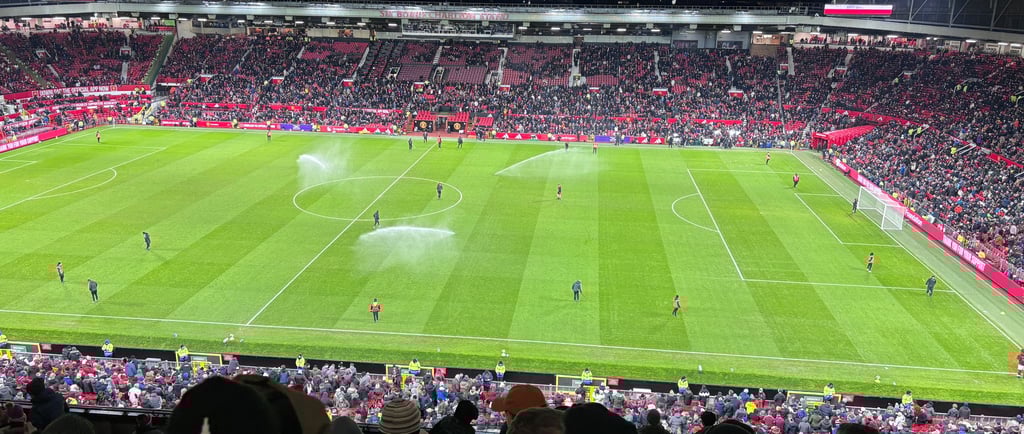
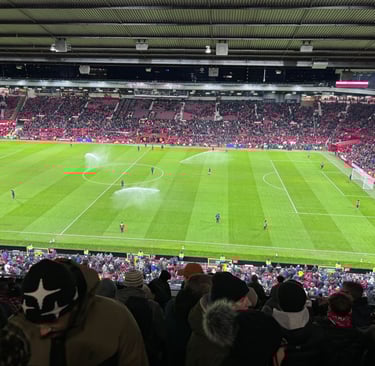
Let’s be clear: this was the most complete performance by a Manchester United side since the days of Sir Alex Ferguson.
What makes it genuinely astonishing is the context. A new manager. A new coaching setup. Barely 72 hours in the job. No pre-season. No transfer window. No time to embed complex ideas. And yet what we saw at Old Trafford was dominance - tactically, physically, mentally - from the first whistle to the last.
Make no mistake about it – 2-0 flatters City. United hit the framework twice, had three goals chalked off for offside, and forced Donnarumma into a number of fine saves.
Maybe I’m over-egging it in the heat of the moment. Maybe emotion is doing some of the talking. But that’s kind of the point. Performances like this don’t happen by accident, and they certainly don’t happen by luck alone.
Yes, it must be acknowledged that this was - by their own ridiculously high standards - a fairly average Manchester City side that turned up. That contributed to the scoreline. But the scale of United’s dominance raises uncomfortable questions about how badly this group of players was managed previously. It also points to a very bright future for the rest of the season - if, and it’s a big if, consistency can be maintained.
As I see it, there were five key elements behind this remarkable victory.
1. Square pegs for square holes
Let’s start with the captain: Bruno Fernandes.
On any metric, he is one of the best number 10s in world football. You can debate whether he’s the best in the Premier League, but he is unquestionably our best number 10. Which makes the decision by Ruben Amorim to retreat him into a quasi-defensive number-six role for the best part of a year nothing short of criminal.
Michael Carrick - and credit where it’s due, under Darren Fletcher as well - Fernandes was pushed back into attacking areas. The folly of Amorim’s approach has been laid bare.
But it wasn’t just Bruno.
Amad Diallo is an attacking player. He wants to take people on, beat his man, put in a cross or get a shot away. Why he was ever used as a right wingback is baffling. It dulled his strengths and exposed his weaknesses - for no tactical gain whatsoever.
Then there’s Luke Shaw. Bought as one of the best left-backs in Europe - certainly the best English full-back at the time. Injuries and form issues haven’t helped his United career, but what on earth was he doing at left centre-back when he’s still capable of producing that performance from his natural position?
These were not isolated mistakes. Amorim prioritised his system above the players. He created the “holes” first, then forced whatever “pegs” he had into them. Shape didn’t matter. Fit didn’t matter. And after a year, we knew it didn’t work - bar the odd short burst.
Carrick fixed that immediately.
2. Restoring the United DNA
United has a fabled history with its academy. Few decisions under the previous regime were more baffling than the marginalisation of Kobbie Mainoo.
It frustrated fans. It frustrated people inside the club. And by all accounts, it even frustrated the ownership - reportedly one of the flashpoints between Amorim and those higher up the chain. When you’ve got a talent that good, you build around him for the next five, six, eight years.
Carrick showed superb management here.
First, he reinstated Mainoo straight into the starting XI - no hesitation, no easing in. Second, and crucially, he paired him with Casemiro.
For a year we were told those two couldn’t play together. That it wouldn’t work. That the balance was wrong. Yet mixing youth and experience has been a winning formula across football - and across sport - forever.
There was a moment after the second goal where Casemiro and Mainoo were locked in conversation, chest-pumping, geeing each other up. Constant communication. Clear partnership. Mutual understanding. And it worked brilliantly for the entire match.
If Carrick could see that in three days, why couldn’t Amorim see it in twelve months?
And beyond personnel, Carrick restored something deeper: quick tempo, pace and fearlessness in attack.
Think Kanchelskis. Lee Sharpe. Giggs. Beckham’s delivery. Ronaldo. Valencia. Nani. Steve Coppell in the 80s. Go back further and you’ve got George Best. United have always attacked down the wings, with speed, intent, and a willingness to take risks.
Attack has often been United’s best form of defence - and City knew it.
Once the first goal went in, their back line looked nervous. They knew United could counter - quickly and brutally. Some of the best Ferguson-era goals came that way. Peter Schmeichel was famous for launching attacks instantly. Some of the best goals United scored under Ferguson were with sweeping attacks where oppositions couldn’t cope with the pace and ingenuity of a wave of attack.
Sure, we’ve seen some of those goals in recent years, particularly under Solksjaer and occasionally with Ten Hag, but this felt different. For the first time in a long while, United resembled a prize fighter, coiled, ready to unleash at any moment you let your guard down. Sure, we didn’t land many punches, but the threat was almost constant, the control was absolute.
Contrast that with recent seasons, where attacks died because the ball was slowed, recycled, and allowed opponents to reset. Carrick brought back tempo - and City couldn’t live with it.
3. A collective defensive performance – intelligence, partnerships, and purpose
On the left, Dorgu and Shaw worked as a disciplined partnership, and on the right, Diallo and Dalot did exactly the same. The focus wasn’t just on stopping City out wide, but on blocking the inside channels — the spaces City rely on players like Foden and Bernando Silva for their creativity and positive runs between the lines. Time and again, those lanes were closed off early, forcing City sideways or backwards rather than through United. Even when their wide players got the ball, they were unable to produce anything of substance.
The effectiveness of that approach was underlined by Pep Guardiola’s decisions: Foden, normally one of City’s most influential players in those pockets (particularly against United), was withdrawn at half-time, having been rendered almost anonymous. And when even Haaland was taken off with ten minutes to go, it was a clear admission that City’s usual routes to goal had been completely shut down.
What stood out defensively wasn’t just the work of the four wide players. Yes, the combinations on either flank were excellent, but this was a team-wide defensive effort, built on intelligence, awareness, and constant communication.
Casemiro and Mainoo were central to this. They knew exactly when to support, when one of them needed to drift wide to help block a channel - particularly when Dorgu or Diallo hadn’t yet recovered from an attacking phase. If United were momentarily stretched on the right, you’d see Dorgu tuck inside to block the inner channel. When City tried to overload the opposite side, Dalot would squeeze infield to keep the defensive shape compact.
This wasn’t random movement. It was collective problem-solving in real time. United defended not just as individuals, not just in pairs, but as an entire unit moving intelligently together.
The outcome speaks for itself. City were restricted to one shot on target across the entire match. Their expected goals figure was the second lowest they’ve recorded since Guardiola took charge — a remarkable statistic.
It’s important to reflect on goalkeeping. Onana was not De Gea - but nor has he been protected in the way De Gea was at his best. He faced far too many shots during his time at United because United were defensively poor, and that inflated the number of goals Onana faced, and therefore conceded. The same applies to Lammens - goalkeepers suffer when defensive structures collapse.
Van der Sar holds the record for the longest run without conceding a goal, a record that may never be broken. But that didn’t happen in isolation. In front of him were Ferdinand and Vidic - arguably the best central defensive partnership the Premier League has ever seen. Their greatest contribution was reducing the number of shots he had to face.
That’s exactly what United did here.
Martínez and Maguire were outstanding. Martínez, even in the rare moments he was isolated against Haaland, defended aggressively and intelligently - blocking space, denying movement, refusing to allow Haaland to run the channels or get a clean shot away. Maguire dealt with crosses with total authority. Every high ball was attacked with purpose and conviction.
It makes his performance all the more impressive given he hasn’t trained consistently for nearly three months. That level of readiness speaks volumes about his professionalism and attitude. Martínez, too, deserves huge credit - particularly as he has not long returned from a serious long term injury, but the criticism he received only days ago from former players. Those comments already look ill-judged.
This defensive cohesion was not accidental. It was coached, organised, and executed with clarity. And it was a massive part of why City were completely neutralised.
4. Rebuilding the connection between the team and the fans
Another major thing Carrick got right was restoring the connection between the team and the supporters.
Old Trafford felt like home again.
Too often in recent years - even in big games - the fans have turned up ready, but the performance hasn’t matched the occasion. The volume drops, the energy drains, and the atmosphere fades because the players simply haven’t shown intent or understanding of what the shirt represents.
This time was different.
Carrick spoke after the match about emotional control - not suppressing emotion but using the right emotion. That matters. Sport is emotional. Fans invest everything. They turn up hoping, willing, believing - because if they could be on the pitch themselves, they would.
Yes, it was a derby, and that always adds something. United have had big performances against City before - including the FA Cup final win - but this felt different. This was sustained purpose from minute one to minute ninety.
You could see it in the little moments. Players gesturing to the crowd during stoppages. Asking for noise. Trying to keep the momentum alive. And the fans responded in kind.
There was a genuine feedback loop - the players lifted the crowd; the crowd lifted the players. Old Trafford was the 12th man in the truest sense.
That Carrick managed to convey the importance of that connection within three days is extraordinary. It’s something that’s been missing for far too long - and its return was unmistakable.
5. No let-up – ninety minutes of work, energy, and sacrifice
The final thing Carrick got absolutely right was demanding total commitment for the full ninety minutes.
There was no drop-off. No coasting. No managing the game by slowing it down. United ran themselves into the ground.
The number of sprints, recoveries, and repeated high-intensity actions must dwarf anything we’ve seen from this group in recent seasons. By full-time, some players could barely stand. Adrenaline carried them off the pitch - not energy.
Bruno Fernandes set the tone, as he always does, before being replaced by Mount, who immediately continued the work. Cunha did the same when he came on. Casemiro, written off by many as finished, covered ground relentlessly - breaking up play, supporting attacks, getting back into position again and again.
This wasn’t about one or two players digging deep. It was everyone. Every shirt. Every role. Getting back, pushing forward, supporting each other.
And that’s all fans ever really ask for.
Talent matters. Quality matters. Tactics matter. But above all, supporters want to see players earn the right to wear the shirt. To put in a shift. To leave everything out there.
That’s exactly what happened.
A glimpse of what could be
In the end, United only get 3 points. The performance doesn’t erase past failures. And it guarantees nothing.
But it does change what feels possible. No longer can pundits say that the players aren’t good enough.
It shows this squad is far better than we were led to believe. It exposes how poorly it was previously managed. And it offers a genuine glimpse of what could lie ahead if clarity, balance, intensity, and belief are maintained.
Consistency remains the challenge - and it’s a huge one. But for the first time in a long while, United look like they’re moving forward instead of endlessly starting again.
And after everything we’ve endured, that alone feels like progress.
Community
Connecting fans worldwide, celebrating heritage and values.
Contact
© 2025. All rights reserved.
Powered by IT CORE SERVICES LTD